
Our Portfolio
Our team possesses extensive experience in addressing challenges related to oil and gas extraction in both conventional and unconventional reservoirs. We have also successfully handled projects in geothermal reservoirs and underground gas storage. Rest assured that our expertise covers a wide range of reservoir types, making us well-equipped to deliver successful outcomes for your endeavors.
Water intrusion in a carbonate reservoir
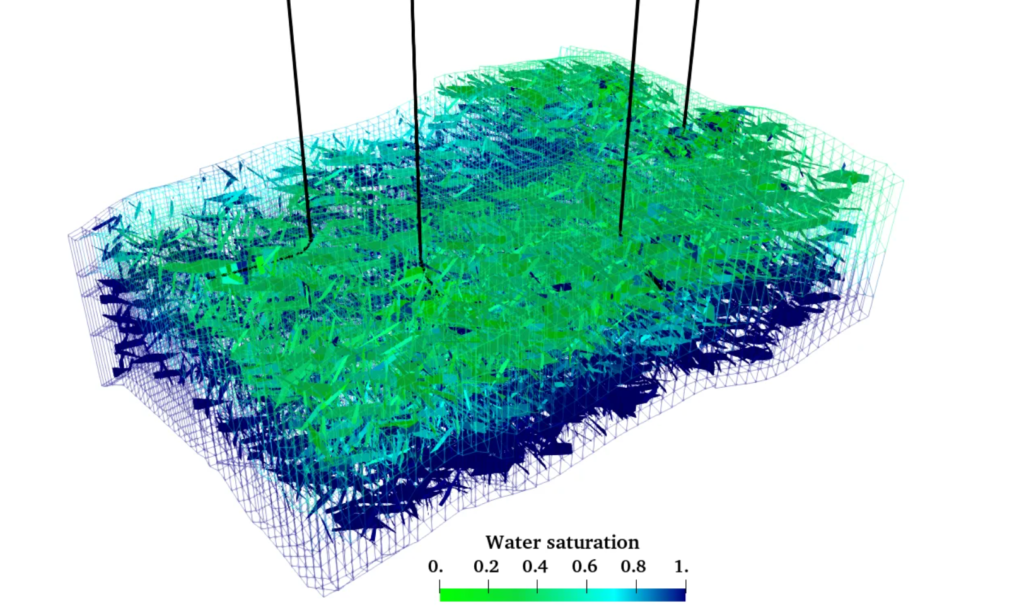
In this particular case, the challenge lies in accurately characterizing the water intrusion behavior within a carbonate gas reservoir. The conventional dual porosity dual permeability (DPDK) methods employed in the past have shown a tendency to overestimate fracture connectivity, leading to inaccurate estimations of water breakthrough.
To tackle this challenge, the implementation of embedded discrete fracture model (EDFM) proved to be an effective solution. By utilizing EDFM and conducting thorough history matching, the dominant paths that significantly influence water intrusion behavior were successfully captured. As a result, the operator was able to adopt various field development practices to optimize completion designs in other areas of the reservoir.
This achievement demonstrates the practical significance of employing EDFM and leveraging its capabilities to enhance reservoir characterization and subsequent decision-making processes.
Production optimization in a carbonate reservoir

The challenge of accurately simulating fracture flow was attributed to the presence of a significant number of fractures. To address this challenge, the model incorporated the use of EDFM to seamlessly integrate fractures into the matrix grid.
This integration was achieved non-intrusively by utilizing a commercial reservoir simulator. The implementation of EDFM led to the successful history matching of the full field model. As a result, there was a notable increase in oil production, and more effective water management strategies were obtained, thereby improving overall reservoir performance.
Well placement optimization in a carbonate field

Accurately simulating fracture flow faced a significant challenge due to a large number of fractures. To overcome this challenge, a solution was implemented by integrating EDFM into the existing model. This integration process seamlessly embedded the fractures into the matrix grid, utilizing a commercial reservoir simulator without causing any disruption.
The positive outcomes of this implementation were evident in the successful history matching of the full field model. Consequently, the reservoir exhibited an increase in oil production, and the adoption of improved water management strategies further enhanced its overall performance.
Fracture modeling and simulation in unconventional reservoir

The challenge at hand involves accounting for the distribution of natural fractures within the reservoir. To tackle this challenge, the solution proposed is to utilize ZFRAC-RE, a method that considers the influence of natural fractures. By seamlessly connecting the simulation results of complex fracture network fracture propagation with the EDFM pre-processor, an accurate assessment of production performance can be achieved.
The results obtained from this approach are promising, as the activated natural fractures effectively characterize the stimulated reservoir volume. This characterization serves as a solid foundation for optimizing well spacing in oil and gas reservoirs that contain natural fractures.
Hydraulic fracture calibration using microseismic

The challenge in the post-frac evaluation process arises from the difficulty of matching the stimulated reservoir volume (SRV) generated by fracture propagation in the natural fracture network with the SRV represented by microseismic data. This challenge is due to the consideration of natural fractures or discrete fracture network (DFN) in the simulation of fracture propagation.
To overcome this challenge, a solution is proposed to calibrate the distribution of natural fractures in the activated area using microseismic signals. This calibration process provides an effective approach for accurately simulating hydraulic fracture propagation while adhering to the constraints imposed by microseismic data.
The results obtained from this approach demonstrate that by utilizing microseismic signals, the distribution of natural fractures can be corrected, and the half-length of hydraulic fractures can be accurately determined within the limitations of the actual microseismic data. As a result, the SRV of the stimulated region aligns well with the observed microseismic signal, indicating a successful integration of fracture propagation and microseismic evaluation.
Hydraulic fracture propagation in complex stress environments
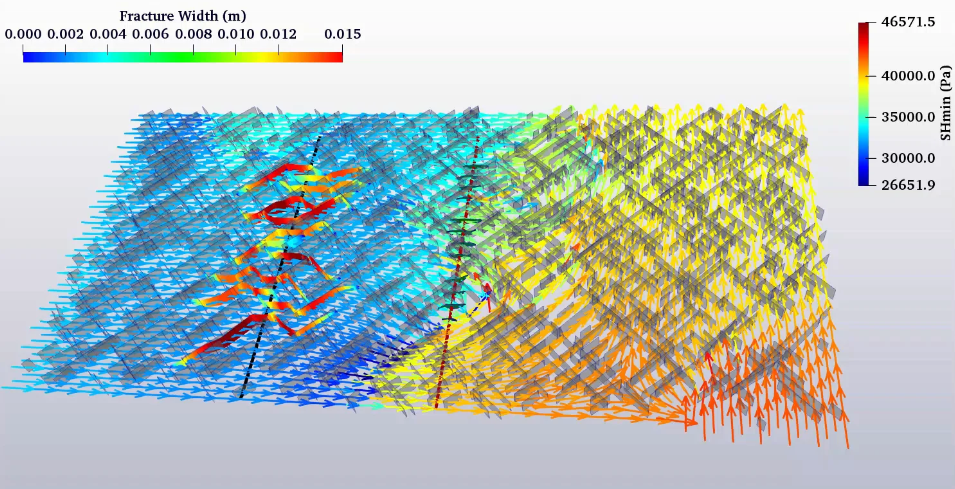
This particular case presents two key challenges that need to be addressed. The first challenge involves accounting for the heterogeneous stress distribution in accordance with the actual configuration of the horizontal well. The second challenge revolves around accurately representing the significant stress variations along the lateral section of the horizontal well. To overcome these challenges, the adopted solution is ZFRAC-RE.
This approach focuses on constructing a comprehensive plane stress distribution based on the interpretation of stress logs specific to the horizontal well. By precisely capturing the stress conditions of each cluster along the well trajectory and conducting pressure matching under complex stress conditions, ZFRAC-RE successfully addresses the challenges associated with hydraulic fracture propagation.
As a result, the implemented optimization plan in the field proves to be highly effective, taking into consideration the intricate interplay between stress distribution characteristics and the complexity of hydraulic fracture behavior.
Geothermal reservoir evaluation
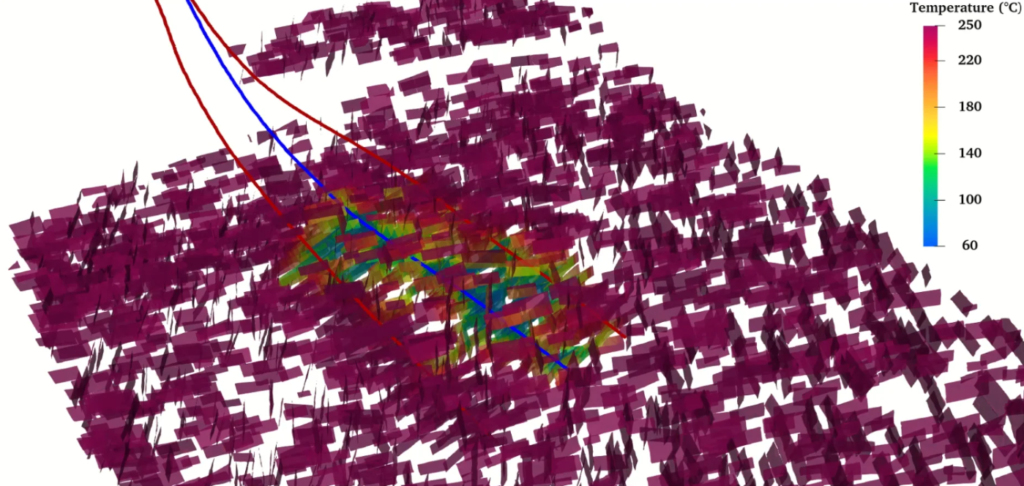
The evaluation of an enhanced geothermal system asset in a naturally fractured reservoir presents a notable challenge. To address this challenge, a solution is implemented through the utilization of Thermal EDFM. This approach facilitates the simulation of convective and conductive heat transfer processes within each fracture of the reservoir’s fracture network.
By incorporating Thermal EDFM, the effects of fracture connectivity are accurately captured, leading to the direct determination of heat extraction efficiency. The obtained results play a critical role in the decision-making process, providing valuable insights into the asset’s performance and potential.
This comprehensive analysis supports informed decision-making and aids in optimizing the operation of the enhanced geothermal system asset within the naturally fractured reservoir, ultimately maximizing the utilization of geothermal resources.
Geothermal well placement optimization in a high permeability reservoir
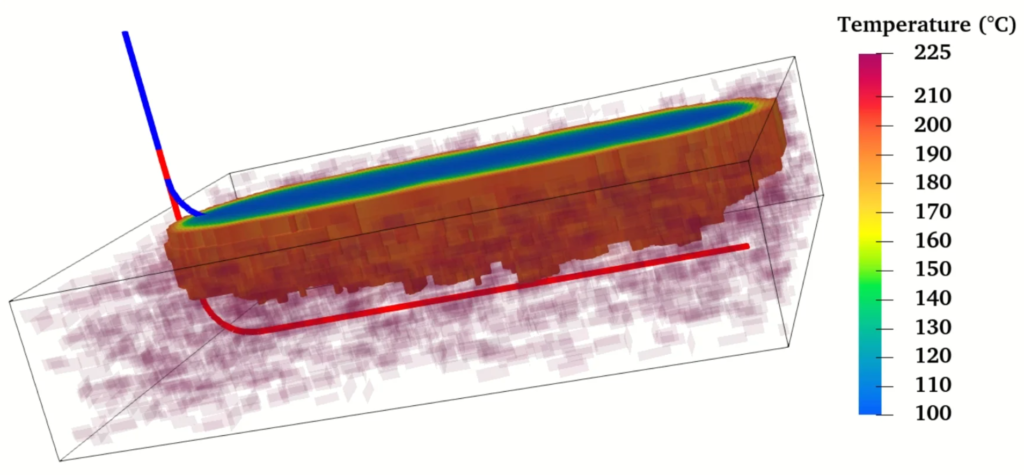
The primary objective is to determine the most effective well placement strategies for maximizing electricity generation in a geothermal reservoir. To address this objective, a solution is implemented through a comprehensive analysis of the fracture network’s influence within the high permeability reservoir.
By conducting sensitivity analysis, the impact of the fracture network on electricity output is thoroughly evaluated. The results of this analysis indicate that the deployment of two horizontal wells, positioned in a horizontal direction, represents the optimal well design for generating higher electrical power over time.
This finding carries significant implications for decision-making, providing valuable guidance for selecting the most favorable well placement strategies that harness the full potential of the geothermal reservoir and optimize electricity production.
Reservoir quality for hydrogen storage assessment
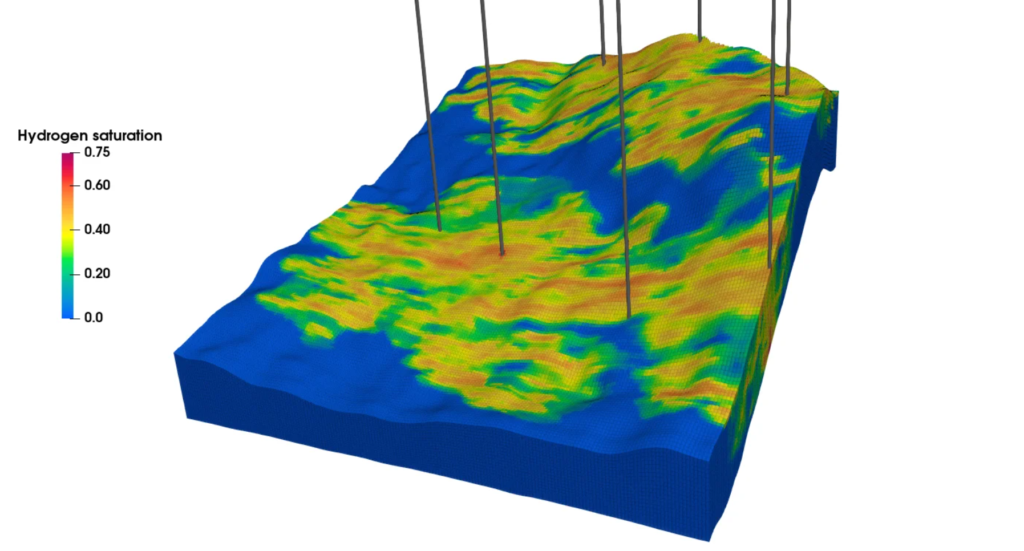
When confronted with the objective of identifying the most suitable storage options for hydrogen, a series of comprehensive solutions were implemented. To achieve this, a detailed modeling plan was meticulously developed, employing a commercial reservoir simulator in conjunction with the expertise of our professionals.
Through the utilization of this modeling plan, an in-depth compositional reservoir simulation was conducted, leading to a thorough evaluation of potential storage options. The results of this evaluation highlighted both saline aquifers and depleted oil reservoirs as highly promising candidates for hydrogen storage, demonstrating their efficacy and reliability.
Furthermore, as part of an exhaustive analysis of the results, special operational practices were recommended to optimize the storage process. By considering these practices, the overall performance and efficiency of hydrogen storage can be further enhanced.
The successful evaluation of saline aquifers and depleted oil reservoirs, combined with the suggested operational practices, offer valuable insights and guidance for decision-making in the realm of hydrogen storage. This comprehensive analysis paves the way for the development of effective storage strategies, fostering the utilization of hydrogen as a secure and sustainable energy storage solution.